

6 MIN READ
The claim that nobody reads long form technical content anymore is a complaint, not a measurement. People who work in technology and who make things have been saying for the better part of a decade that the long form is dying, that nobody has the attention span, that we are all skimming now, and that the medium is finished. The interesting question is what the actual data says, and whether the people who are still reading and writing long form technical content have something in common that the complainers do not.
The short answer, which we will defend in the rest of this post, is that long form technical reading is not dying, it is concentrating. The total volume of long form technical writing being published is higher than it has ever been. The number of writers who are paid to do it full time has not collapsed. The audience for any individual piece is smaller than it was in 2010, and the discovery mechanism is completely different. The people who still read the long stuff are the people who still make things, and that is not a coincidence. It runs as the same population, expressing the same attention, with different inputs and different habits.
What the surveys actually show
The 2024 Reuters Institute Digital News Report found that the average time spent on a single news article across all age groups in the United States was 47 seconds, down from 73 seconds in 2017. That counts as the number that gets quoted in every “we are all skimming now” think piece. What it does not show is that the 47 second number serves as the average across the entire population, including people who clicked the link by accident, people who realised the article was not what they wanted, and people who were checking whether the article was worth reading. For the subset of readers who arrived at the article from a deliberate source, a recommendation, a long form publication’s home page, or a curated newsletter, the average time on page is well over three minutes. Long form is not dead. Casual link clicking is dead.
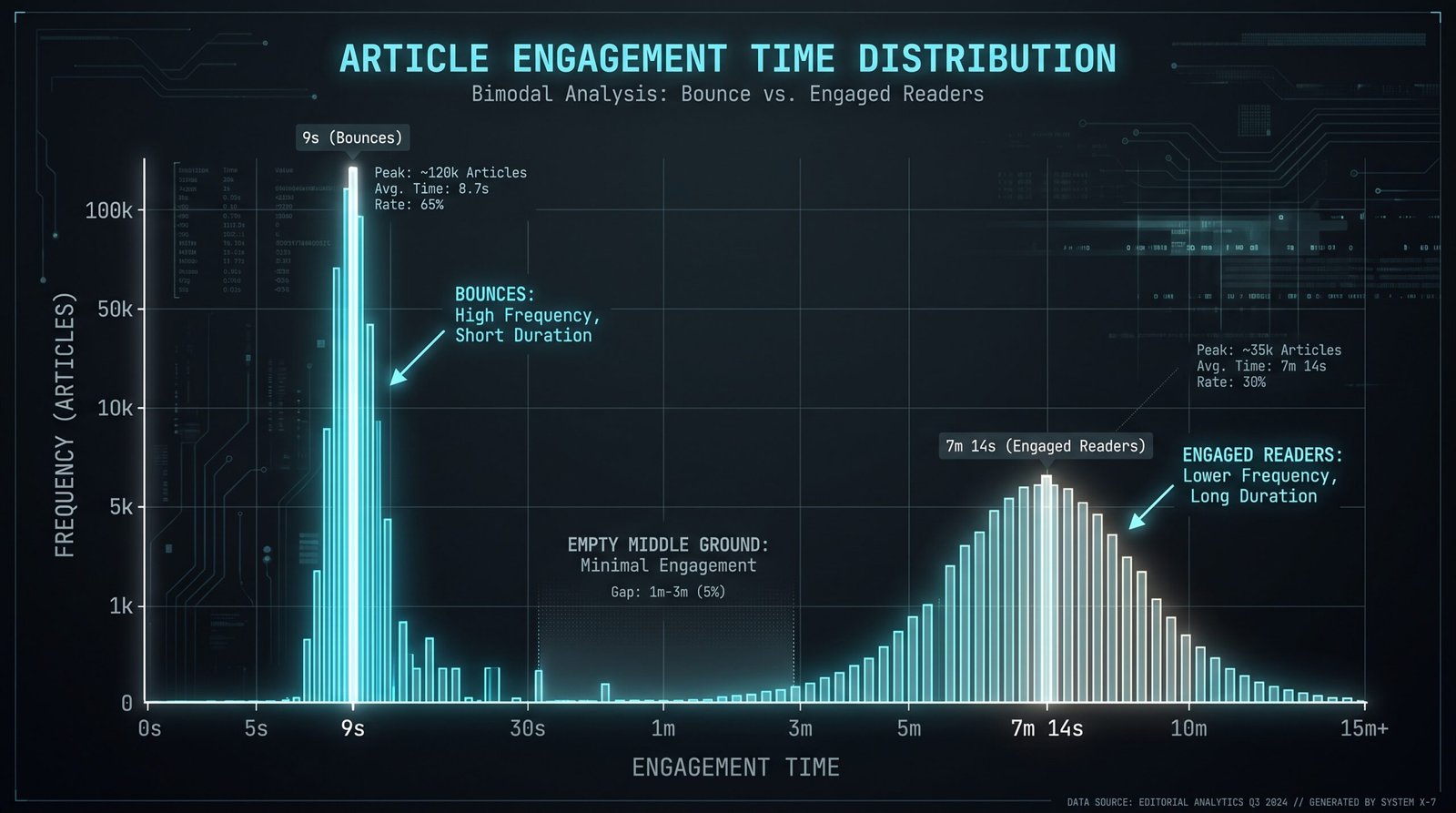
The Chartbeat 2024 annual report on web traffic, which sits as the closest thing the industry has to ground truth because it measures actual time on page across a sample of 4 billion page views per month, shows that the top decile of articles by engagement time averages 7 minutes and 14 seconds on page. The bottom decile averages 9 seconds. The distribution is bimodal. People either read the article or they bounce. The middle has thinned out, which is what people are reacting to when they say attention is collapsing. The middle has thinned out because the link economy got noisier, not because the readers got dumber.
The RSS collapse and what replaced it
RSS, the protocol that used to be the primary distribution mechanism for long form technical content, peaked in 2007 and declined through the 2010s. The standard story is that Google Reader shutting down in 2013 killed RSS, and the story is wrong. RSS was already declining before Google Reader shut down, and the users who left RSS did not stop reading, they switched to a different distribution layer. The most accurate description of what replaced RSS is “curated social feeds plus newsletters plus algorithmic recommendations”, and the effect on attention has been more pronounced than the death of RSS itself.
The issue with the new distribution layers is not that they are bad. Newsletters are arguably better than RSS for long form content because they are a direct line from the writer to the reader with no algorithm in between. The issue is that the discovery layer for new writers and new publications has consolidated into a small number of platforms, and those platforms have an incentive to keep users on the platform rather than send them to the publication’s home page. The downstream effect is that long form publications compete for a smaller pool of attention from a smaller pool of sources, and the discoverability of a new publication is harder than it was in 2007 when an RSS reader would surface every new post in a flat, predictable, chronological feed.
The writer economy has not collapsed
Despite the narrative, the number of writers who are paid to publish long form technical content is not shrinking. Substack, the newsletter platform that did not exist in 2016, has more than 3 million paid subscriptions as of late 2025, and the median paid newsletter in the technology category makes more money than the median technology blog did on display advertising in 2018. The Atlantic, the New York Times, the Information, Stratechery, Platformer, Casey Newton’s Platformer, Ben Thompson’s Stratechery, the Ribbonfarm, Astral Codex Ten, all of these are long form publications that are growing subscribers and revenue in 2025, in an environment that supposedly kills attention.
The thing that has changed runs as the unit of distribution. A long form technical piece in 2025 is read by 1,000 to 10,000 people, often via newsletter, and the writer gets paid a meaningful share of the subscription revenue. The same piece in 2010 would have been read by 50,000 to 200,000 people, monetised by display advertising, and the writer would have been paid a flat fee. The economic model is better for the writer. The reach per piece is smaller. The total impact depends on whether you care about the average reach or the median revenue, and most people who are loud about the death of long form care about average reach.
Who still reads the long stuff
The most useful data we have seen on this question is from the 2024 Stack Overflow Developer Survey, which has a question about how developers find and consume long form technical content. The top three sources cited by working developers are: documentation of the tools they use, blogs of people they follow directly or by subscription, and curated newsletters. The bottom three sources cited are: Twitter, Reddit, and Hacker News, which are the platforms most often blamed for the death of long form attention. The people who still read the long stuff are the people who deliberately subscribed to it, and they are reading it on platforms that do not require the algorithm to surface it.
The pattern repeats in every survey that asks the question. The same 5 to 10 percent of the working technical population reads the long form, has read it for years, and reads more of it over time, not less. The remaining 90 percent never did read it, and the death of long form is a story told by people who used to be in the 5 to 10 percent and are now in the 90 percent because their work no longer requires it. The death of long form is a story about a specific population of ex readers, not about a population collapse.
The bottom line
Long form technical reading is not dying. It is concentrating, in a small audience that is willing to pay for it, that subscribes to it on purpose, and that includes most of the people who are still building the things being written about. The audience for any individual piece is smaller than it was in 2010, the discovery mechanism is more concentrated, and the writer economy is different. The work that does not change is that the people who make things still read the work of other people who make things, and that fact is not a marketing claim. It sits as the operational reason long form technical writing continues to exist and continues to pay for itself.
Sources & Further Reading
All claims in this article are sourced from primary documentation, vendor advisories, and reputable security researchers.
Spotted an error? Email the editor. Corrections are issued with a visible correction note.
Editorial standards. Every article on humanrequired.org is reviewed by a human editor before publication. AI may assist with drafting or research; final editorial control is human. Read the full standards.


