

7 MIN READ
The state of open weight language models in 2026 sits in a strange place. Better than the marketing claims of two years ago. Worse than the headlines suggest. The number of credible open weight models is now around 25 to 30, depending on how the Chinese and the European releases get counted. The capability gap between the best open weight model and the GPT-4o or Claude 4 class has narrowed on a small number of benchmarks and widened on most others. A serious workstation can now run something useful, and a rented H100 has dropped to about 1.3 dollars per hour, which makes a long context experiment cost less than a coffee.
None of this means the open weight story is over. It means the story has gotten complicated enough that a thoughtful practitioner needs to know which model is good at which job, and which is still mostly a demo. This post is the survey we wish we had read at the start of the year. We have been running these models in production and on side projects for the last 12 months. What follows is what we have actually found, with the caveats and the failures.
The model families that matter
Five families worth talking about in 2026, and the rest are either derivatives or research curiosities.
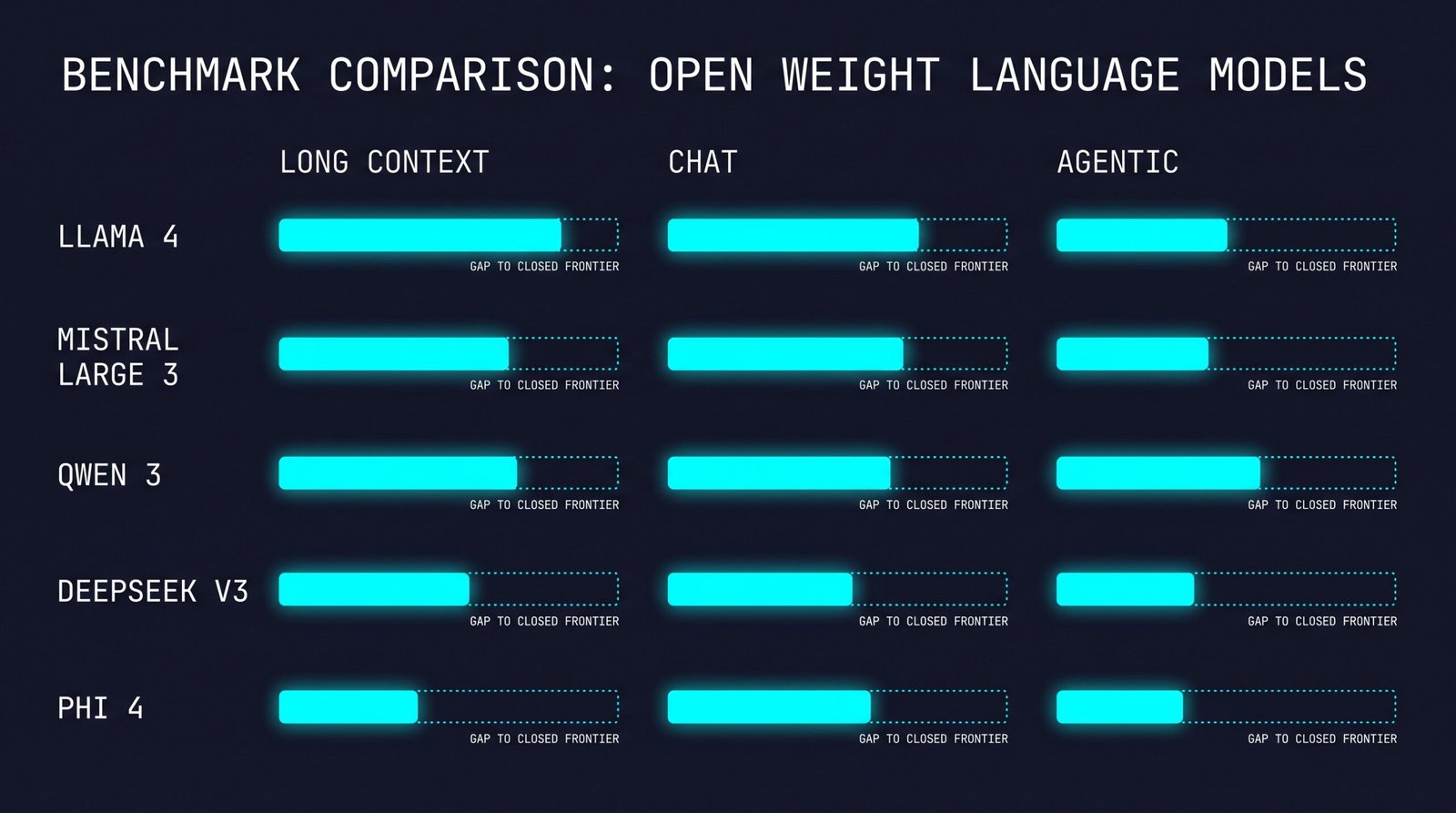
Llama 4 from Meta remains the most widely deployed open weight family. The Scout and Maverick variants are the workhorses, with the Behemoth variant still in limited release as of writing. The instruction tuned versions are the only ones to run unless there is a specific fine tuning use case. Mistral keeps shipping credible models, with Mistral Large 3 and the Mixtral 8x22B mixture of experts being the relevant ones. Qwen 3 from Alibaba has been the surprise of the last 18 months. The dense and MoE variants in the Qwen 3 family are competitive with the closed models on a wide range of tasks, and the licensing is genuinely permissive. DeepSeek V3 was the open weight model that made the closed providers take the open weight story seriously, and the V3.1 and V3.2 releases continue to push capability per parameter. Phi 4 from Microsoft holds the small model category, with the 14B variant being remarkably capable for its size.
Outside of these five, the model landscape fragments into derivatives, fine tunes, and research previews. The number of Hugging Face repositories tagged as language models in 2025 exceeded 1.2 million. Most of them are not worth running. The cost of evaluating a new model is not the inference, it is the time. The 30 to 50 models worth a serious look are all in the five families above.
What each is actually good at
For coding, Qwen 3 Coder and DeepSeek Coder V3 are the current state of the open weight art, with Qwen 3 Coder 480B being the variant most teams run on a multi GPU rig or a rented H100 node. The capability on real world coding tasks is close to the best closed models on the benchmarks the open weight community runs, and the gap is closing each release. For long context retrieval and summarisation, Llama 4 Scout with the 10 million token context window is the workhorse, and the long context performance is genuinely useful for codebase scale work. For chat and general assistance, Mistral Large 3 and Qwen 3 72B are competitive with the closed models at a fraction of the cost. For small scale local deployment, Phi 4 14B and Qwen 3 8B are the right answer, and they run on a Mac mini with 32 GB of unified memory without breaking a sweat.
The places where the open weight models still trail the closed models are well known. Multi step agentic tasks with tool use, particularly when the task requires more than 5 to 10 tool calls in sequence, are still a strength of the closed providers. Multimodal reasoning across image, audio, and video is closer but still favours the closed providers. Reasoning models that are competitive with o3 or Claude 4 Opus on hard math and coding benchmarks are still mostly closed, with the notable exception of DeepSeek R1 and the Qwen QwQ series. If the workload sits in those categories, the closed providers are still the right answer for now.
What it actually costs to run
On a Mac mini M4 with 32 GB of unified memory, the Qwen 3 8B and Phi 4 14B variants run at 30 to 50 tokens per second, which is fast enough for an interactive chat experience. The memory cost is 6 to 12 GB. The electricity cost is negligible. This is the right answer for a personal assistant, a coding helper for small projects, or a privacy preserving local model for sensitive data. The total cost of the hardware is 800 to 1,200 dollars and the model weights are free.
On a single rented H100 with 80 GB of VRAM, the Qwen 3 72B and Llama 4 Maverick variants run at 60 to 100 tokens per second, which is fast enough for a small production deployment. The cost on a major cloud provider is 1.30 to 3.50 dollars per hour, depending on the region and the provider. For a 24/7 production deployment, that is 950 to 2,500 dollars a month, which is competitive with closed API pricing for moderate volume and significantly cheaper for high volume use cases that are bottlenecked on tokens per second rather than capability per dollar.
On a multi GPU rig with 4 to 8 H100s, the full Qwen 3 480B and Llama 4 Behemoth variants can be served, and the inference cost drops to about 0.40 to 0.80 dollars per million tokens at production scale, which is below closed API pricing for the same capability class. The capital cost of the hardware is 200,000 to 500,000 dollars, and the break even point against closed APIs is around 6 to 18 months for a team that is doing serious inference volume. Below that volume, renting is the right answer.
What is still demo ware
Several categories of open weight release still look impressive on paper and are not ready for production. Multimodal models have been the worst offender. A meaningful number of 2024 and 2025 releases shipped with image and audio capabilities that trail the closed equivalents by a wide margin, and the marketing did not reflect the gap. Agentic models fine tuned for tool use routinely fail in production on multi step tasks once the chain runs past a handful of calls. And the small models optimised for leaderboard benchmarks routinely underperform on real work, which is the part the leaderboard does not measure. The benchmarks in 2026 are not a reliable proxy for production performance. A model that wins MMLU is not necessarily a model that is good at the thing that needs doing.
The reliable way to know whether a model is good for a specific use case is to run it on a representative sample of the real production data, measure the failure modes, and compare it against the closed model that would otherwise be used. This is more work than reading the leaderboard. It is the only work that actually answers the question.
The bottom line
The open weight model story in 2026 holds for coding, for general chat at small and medium scale, for long context retrieval, and for any workload where privacy or cost makes the closed providers a non starter. The story is still aspirational for the hardest reasoning tasks, for production scale agentic systems, and for multimodal use cases at the frontier. The right answer for most working teams is a hybrid: the best closed model for the hard cases, the best open weight model for the routine cases, and the discipline to know which is which. The cost savings of running the open weight models on owned hardware are real. The capability gap is real. Both are true at the same time, and the practitioner who understands the difference builds the production system that actually works.
Sources & Further Reading
All claims in this article are sourced from primary documentation, vendor advisories, and reputable security researchers.
Spotted an error? Email the editor. Corrections are issued with a visible correction note.
Editorial standards. Every article on humanrequired.org is reviewed by a human editor before publication. AI may assist with drafting or research; final editorial control is human. Read the full standards.

