

The developer did not become one hundred times smarter. They stopped asking the model to guess what the project needed.
The demos are everywhere. A developer with a coding agent produces a working application in 30 minutes. Another one ships a feature branch in an afternoon that would have taken a team of three a sprint. The implied message is that the AI is now a top tier engineer, and the rest of us are about to be made redundant.
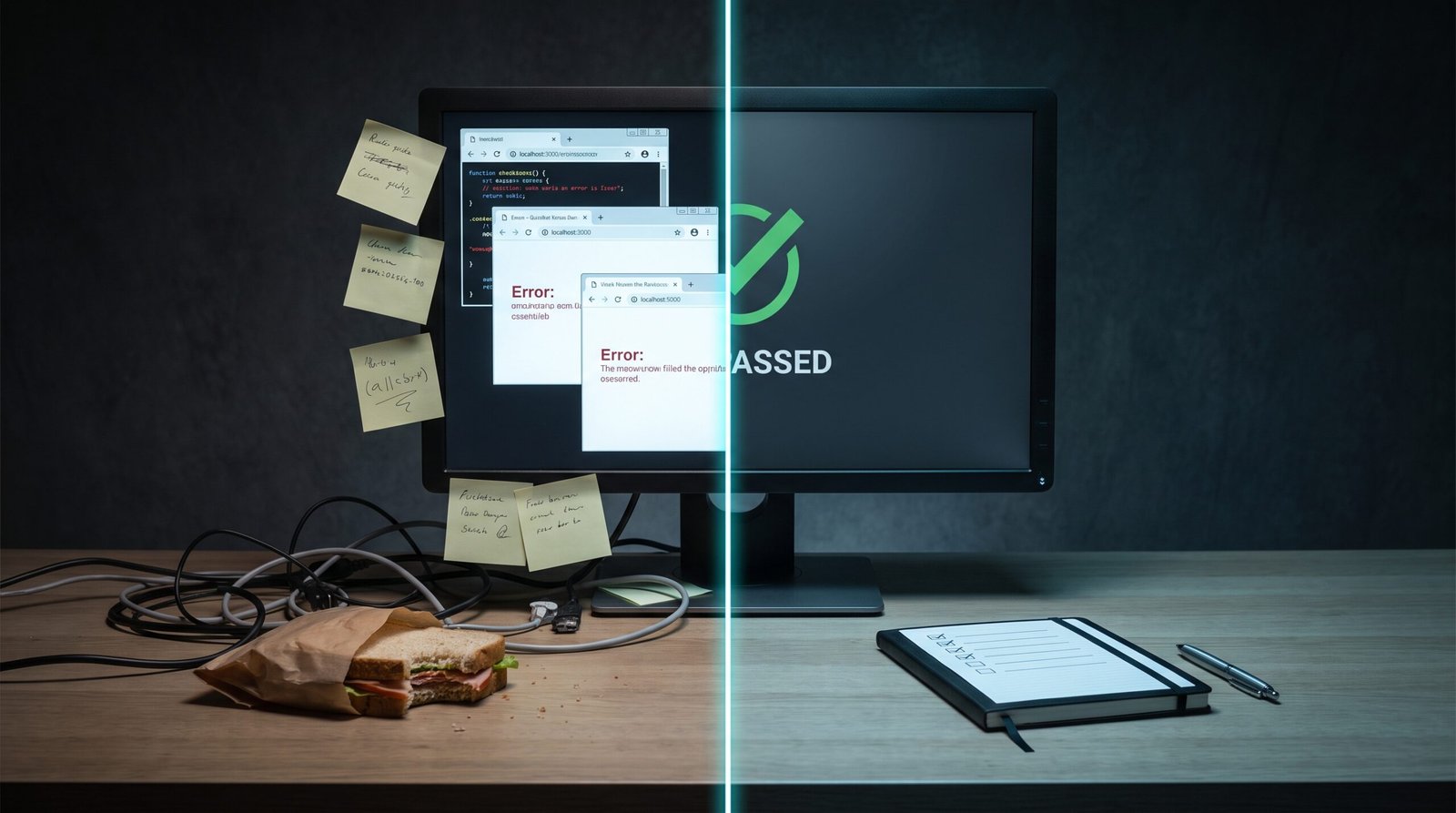
That is not what is happening. What is happening is that the strongest developers have built disciplined systems around the agent, and the difference between a 100x result and a 5x result is almost entirely the system, not the model. The model runs as the same model. The system is what makes it look like magic.
Why identical models produce wildly different results
Give the same model the same task to two different developers and you will get two very different outcomes. One ships working code. The other ships a tangled mess that the team will spend three weeks unwinding. The model is constant. The inputs, the context, the workflow, the review process, and the recovery path are not.
The 100x developer has spent hundreds of hours building those inputs and processes until they are invisible. To a viewer, it looks like the model is doing the clever work. To the developer, it is obvious that the clever work happened in the design of the harness, not in the generation of the code.
Context engineering, not prompt engineering
Prompt engineering is what you write to the model in a single message. Context engineering is what the model sees across the entire session. The context stands as the repository, the documentation, the recent commits, the failing tests, the project conventions, the existing patterns, the relevant decisions, the named entities, the file structure, the dependency versions.
A great prompt is a couple of sentences. A great context is hundreds of files, curated into something the model can actually fit in its window and reason about. The work is in the curation. The model just consumes what you have prepared.
The importance of repository instructions
The single highest use file in any agent driven codebase sits as the repository’s instructions file. CLAUDE.md. AGENTS.md. .cursorrules. .github/copilot-instructions.md. The name varies, the job runs as the same. Tell the agent what this project is, how it is structured, what the conventions are, what the testing story is, what to avoid, and how to verify its own work before declaring done.
A 200 line instructions file, written carefully and updated as the project evolves, sits as the difference between an agent that ships the right thing on the first try and an agent that ships plausible looking code that breaks three things. The instructions file is a forcing function for the human to clarify what the project actually is.
Planning agents and execution agents
The 100x developer almost never gives the agent a goal and lets it run. The goal goes to a planning agent. The plan gets reviewed by a human. The reviewed plan is broken into small tasks. Each small task goes to an execution agent. The execution agent’s output is reviewed. The cycle continues.
The planning step is what kills the large autonomous task pattern. The model is better at small, well defined tasks than at “build me a SaaS app.” Not because the model cannot generate the code, but because the model cannot, on its own, decide what the SaaS app should do, who it is for, what the constraints are, and what success looks like. The plan is human work. The execution is model work. Mixing the two is where projects go off the rails.
Tests as machine readable supervision
The single most underrated tool in the agent driven workflow sits as the test suite. Not because tests catch bugs, although they do. Because tests tell the agent what “done” looks like. A passing test is a specification the model can verify. A failing test is a goal the model can iterate toward.
The 100x developer writes the test first, gives the test to the agent, lets the agent iterate against the test, and only reviews the implementation when the test passes. The test serves as the spec. The spec runs as the supervision. The human is not in the loop on every keystroke. The test is in the loop on every change.
Why large autonomous tasks usually fail
Give an agent a goal like “refactor the authentication system to use the new identity provider” and let it run for an hour, and you will get code that is mostly right, occasionally wrong, and almost certainly missing the second order effects. A migration that drops a column too early. A test that was checking the wrong invariant. A configuration that depends on an environment variable nobody told the agent about.
The failures are not random. They cluster around the parts of the system that the human knew about and did not write down. The fix is not “make the model smarter.” The fix is “make the context more complete, and break the task into pieces small enough that the model can hold all of them in mind at once.”
The human review bottleneck
There is a real ceiling on how fast a single developer can ship with an agent, and it is not the agent’s generation speed. It sits as the human’s review speed. A model can produce 10,000 lines of code in an hour. A human cannot meaningfully review 10,000 lines in an hour. The model is bottlenecked on the human, not the other way around.
The 100x developer reduces the review burden by making the output smaller. Smaller tasks. Tighter scopes. More tests. Cleaner diffs. Less code to read per change. The total work shipped goes up because the per change review is fast, and a fast review loop compounds.
A realistic agentic development workflow
The actual workflow that ships software reliably with an agent looks like this. The human writes a one paragraph spec for the change. The spec includes the goal, the constraints, the affected files, the test plan. The agent proposes an implementation plan. The human reviews the plan. The agent writes the code, the tests, and the documentation in one pass. The human reviews the diff. The agent fixes anything the human flagged. The human runs the test suite manually. The change is committed.
None of this is autonomous. All of it is faster than the version where the human types every line. The use is in the structure, not in the absence of human work.
The bottom line
AI makes disciplined developers faster. It often makes undisciplined developers produce bad software faster. The agent becomes the engine. The system around the agent serves as the transmission. You cannot buy the transmission. You have to build it, in your own codebase, with your own conventions, your own tests, your own review process.
The companies that figure this out will pull away from the companies that do not, not because they have better models, but because they have better systems. The model stands as the commodity. The system amounts to the moat.
Sources & Further Reading
All claims in this article are sourced from primary documentation, vendor advisories, and reputable security researchers.
Spotted an error? Email the editor. Corrections are issued with a visible correction note.
Editorial standards. Every article on humanrequired.org is reviewed by a human editor before publication. AI may assist with drafting or research; final editorial control is human. Read the full standards.


