

5 MIN READ
The local LLM stack in 2026 is, for a specific set of workloads, a real alternative to the cloud API. Privacy sensitive work, where the data cannot leave the perimeter. Cost sensitive work, where the per token bill is breaking the budget. Latency sensitive work, where the round trip to the API is the bottleneck. The local stack fits all three, the cloud vendor would rather the platform org did not notice, and the trade press has been mostly quiet about the trend.
What the open weights models can actually do
The open weights models in 2026 can do a lot more than they could two years ago. The largest open weights models now match the closed frontier models on structured output, on analytical work, and on summarisation. The medium size open weights models run on a single high end consumer GPU, serve a small team, and handle the work that used to need the closed frontier models. The capability gap that justified the cloud default has closed faster than most vendor decks admit.
That is why the open weights models have been quietly adopted by the privacy sensitive enterprise, the cost sensitive developer, and the latency sensitive application. The cloud vendor has been trying to dismiss the trend, the trade press has been mostly ignoring it, and the local developer has been quietly running the work. The signal is in the deploy count, not in the press release.
What the hardware requirements look like
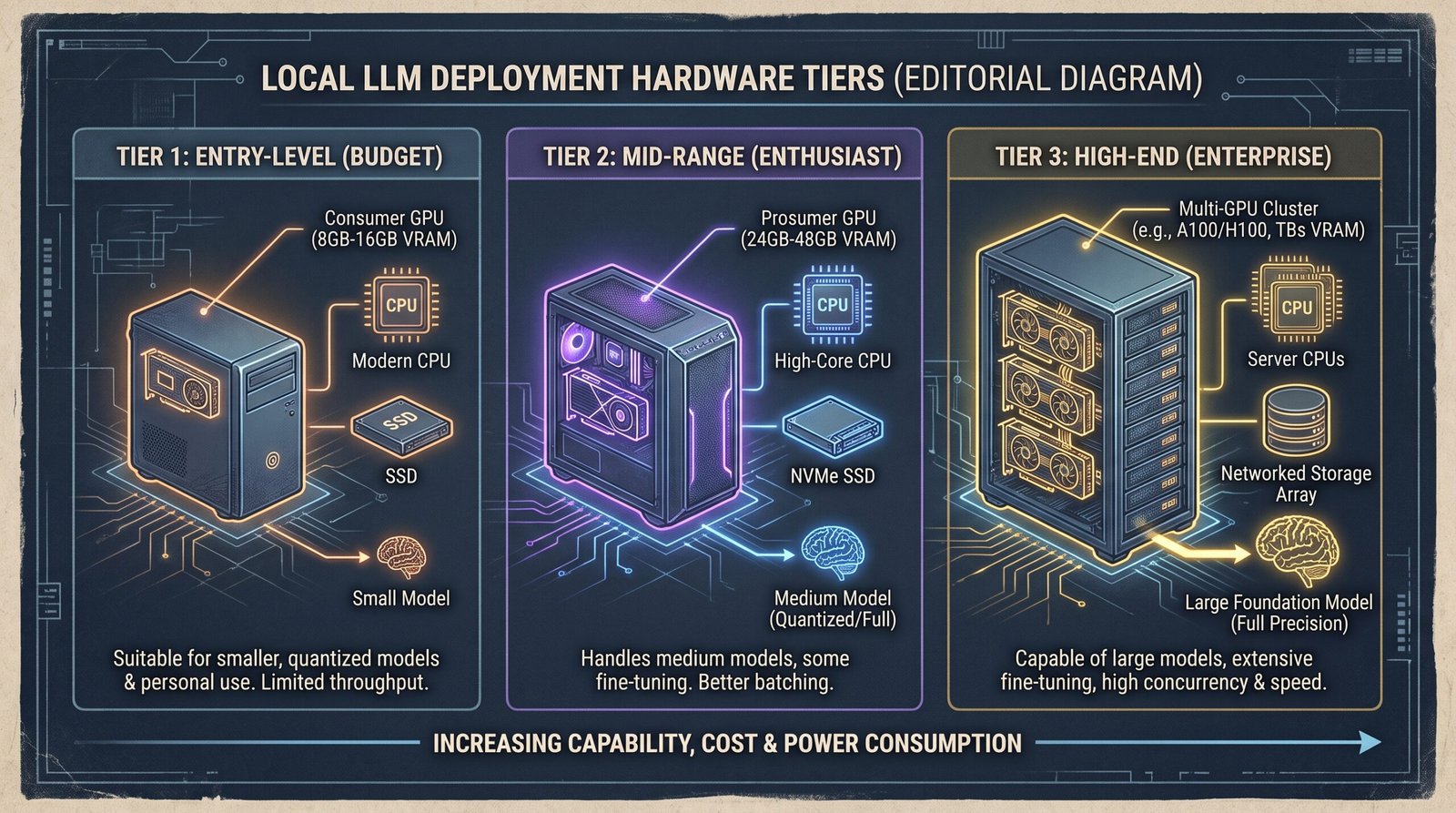
The hardware requirements for the local LLM stack have come down dramatically. A single Mac Studio with 64 GB of unified memory runs a 70 billion parameter model at usable speed. A single Nvidia RTX 4090 with 24 GB of VRAM runs a 13 billion parameter model at usable speed. A single Nvidia RTX 5090 with 32 GB of VRAM runs a 30 billion parameter model at usable speed. A multi GPU setup with 4x RTX 4090 runs a 70 billion parameter model at usable speed. A multi GPU setup with 2x Nvidia H100 runs a 400 billion parameter model at usable speed.
The hardware is no longer the bottleneck. It is no longer the cost the platform org cannot afford, and it is no longer the box the developer cannot deploy. The price curve keeps falling and the speed keeps climbing. What was a research project two years ago is a commodity workload today, and the procurement lead who spec’d the GPU box in 2024 is already looking at the next refresh.
The part about the workloads that are going to stay in the cloud
Not everything moves local. Training large models, running the largest inference workloads, and serving the work that needs the very latest model still live in the cloud for now. The cloud vendor is right about those workloads, and pretending otherwise would be daft. The wrong takeaway would be to assume the rest of the workload portfolio follows them out the door.
What the right stack looks like
The right local stack in 2026 sits as a combination of the hardware, the inference engine, the model, and the application layer. The hardware runs as a single Mac Studio for the small workloads, a multi GPU setup for the medium workloads, and a multi node setup for the large workloads. The inference engine is llama.cpp, vLLM, or Ollama. The model becomes the open weights model that fits the workload. The application layer amounts to the open source framework the engineering org already runs.
Put those four together and the right stack amounts to the one the local developer already deploys. The local enterprise is catching up. The cloud vendor is still pretending the trade press is on their side. The right stack amounts to the one the work fits, not the one the press writes about.
The bottom line
The local LLM stack in 2026 is real, and it is the right answer for the privacy sensitive, cost sensitive, and latency sensitive workloads. The open weights models can do a lot more than they could two years ago, the hardware has come down dramatically, and the local stack sits as the part the trade press has been ignoring. Training, the largest inference, and the work that needs the very latest model stay in the cloud. The platform orgs that have the local stack are doing this well. The ones still sending everything to the cloud are paying for it.
Sources & Further Reading
All claims in this article are sourced from primary documentation, vendor advisories, and reputable security researchers.
Spotted an error? Email the editor. Corrections are issued with a visible correction note.
Editorial standards. Every article on humanrequired.org is reviewed by a human editor before publication. AI may assist with drafting or research; final editorial control is human. Read the full standards.


