Every CVE announcement looks the same. The vendor publishes a security advisory. The advisory has a CVE number, a CVSS score, a list of affected versions, and a recommendation to patch. The defender reads the advisory, prioritises the patch, and moves on. The defender who reads the advisory like a defender, not like a marketer, will catch the difference between a vulnerability that matters and a vulnerability that does not. The difference is in the details. The difference is in what the vendor is not saying. The difference is in the operational impact, not the CVSS score.
What the CVSS score is actually telling you
The CVSS score is a measure of theoretical severity, not operational risk. A vulnerability that scores 9.8 on CVSS can still be irrelevant to your environment if you do not run the affected product, or if the affected code path is unreachable in your configuration. A vulnerability that scores 5.0 on CVSS can be a crisis if the vulnerable code is in a product you depend on, in a configuration you actually use, and on a system that is exposed to the internet. The CVSS score does not know your environment. The CVSS score is a starting point, not a verdict. The defender who treats CVSS as gospel wastes time patching the wrong things. The defender who treats CVSS as input and applies operational context gets the prioritisation right.
What the vendor is not saying
Three categories of silence to watch for. First comes the affected versions list. The vendor says “affects versions 2.0 through 2.7” and the fix sits in 2.8. The defender who has 1.9 deployed treats the advisory as not relevant. The defender who has 2.7.1 deployed treats the advisory as urgent. The defender who has 2.0 deployed, but with a feature flag that disables the vulnerable code path, treats the advisory as lower priority. The affected versions list represents the vendor’s data, not the operational data. Second comes the mitigation guidance. The vendor says “no mitigation available, patch immediately.” The defender who has a WAF, a network segmentation, or an alternative product on the same network path can apply a compensating control and patch on a slower schedule. The vendor does not know the defender’s compensating controls. Third comes the exploitation status. The vendor says “no known exploitation” or “active exploitation in the wild.” The exploitation status serves as the single most important signal in the advisory. A vulnerability with active exploitation and a CVSS of 6.0 runs more urgent than a vulnerability with no exploitation and a CVSS of 9.8. The CISA KEV catalog tracks the actively exploited vulnerabilities. The defender who consults the KEV catalog before prioritising the patch queue gets the order right.
How to read the disclosure like a defender
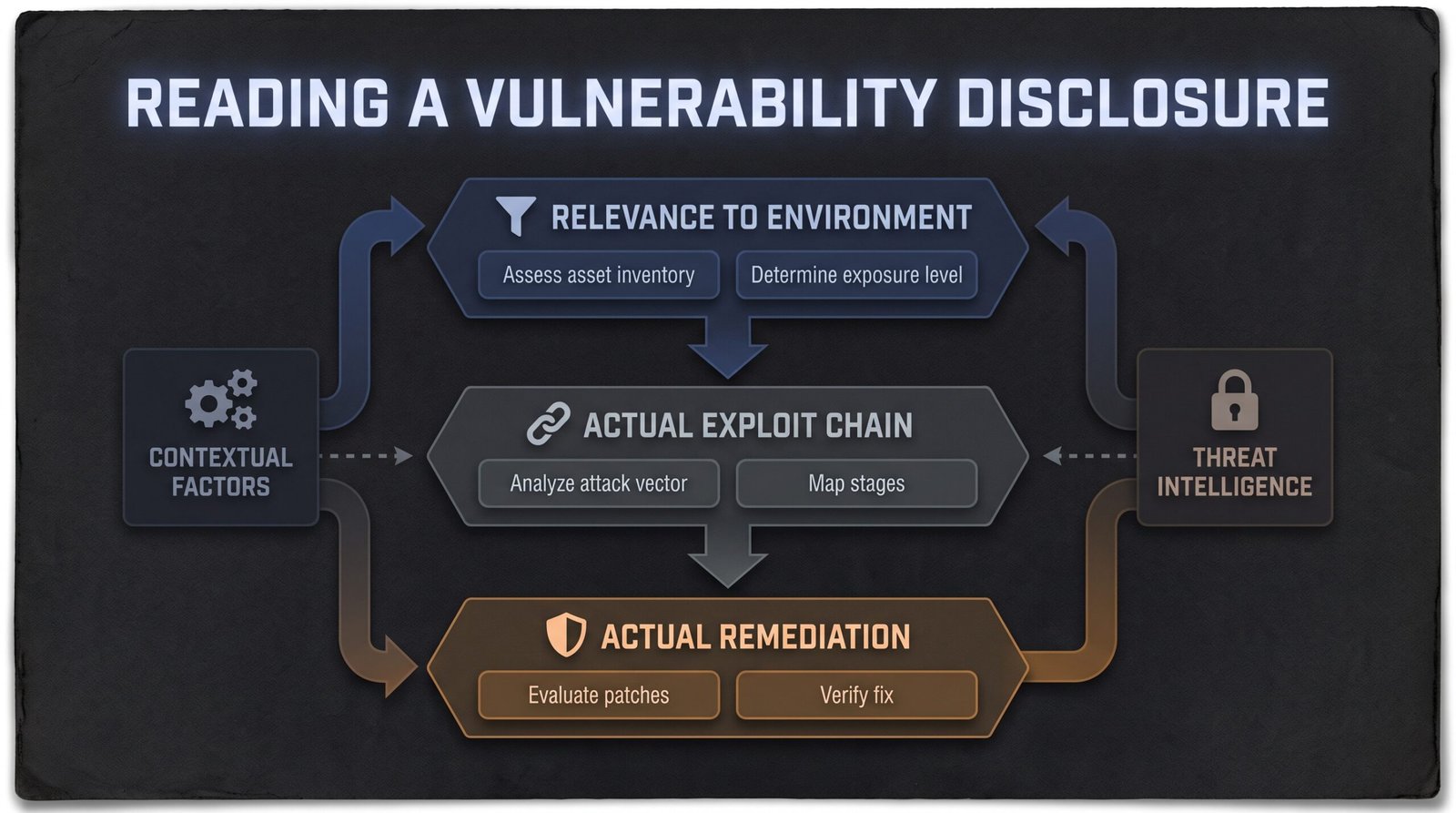
Five questions, in roughly the order to ask them. First comes the affected versions question. Does this product, this version, this configuration apply to my environment? Second comes the exploitation status question. Active exploitation, proof of concept only, or theoretical? Third comes the operational impact question. If exploited, what does the attacker get? Remote code execution as root differs from information disclosure on a metadata endpoint. Fourth comes the compensating control question. Does the defender have a WAF, segmentation, or alternative product that mitigates the vulnerability? Fifth comes the patch availability question. Is the patch available, in the defender’s preferred release channel, with a tested rollback path? The five questions together produce the operational priority. The CVSS score serves as one input. The other four carry more weight.
The bottom line
CVSS is a starting point, not a verdict. The defender who reads affected versions, exploitation status, operational impact, compensating controls, and patch availability gets the priority right. The defender who only reads CVSS wastes time patching the wrong things. The CISA KEV catalog serves as the single most important signal. Start there.
Sources & Further Reading
All claims in this article are sourced from primary documentation, vendor advisories, and reputable security researchers.
Spotted an error? Email the editor. Corrections are issued with a visible correction note.
Editorial standards. Every article on humanrequired.org is reviewed by a human editor before publication. AI may assist with drafting or research; final editorial control is human. Read the full standards.